Author: Emmanuel Oyelayo
Background
Antimicrobial resistance (AMR) occurs when bacteria, viruses, fungi, and parasites evolve to withstand the medications designed to destroy them, turning standard infections into severe, untreatable public health threats [1]. Globally in 2021, an estimated 4.71 million deaths were associated with bacterial antimicrobial resistance, of which 1.14 million were directly attributable to antimicrobial resistance [2].
In clinical care, selecting the correct antibiotic relies on laboratory procedures known as Antimicrobial Susceptibility Tests (AST), which determine which drugs are likely to be effective against the specific microorganism causing a patient’s infection [3]. These tests are usually carried out through disk diffusion, in which laboratory technicians place antibiotic-infused paper discs on an agar plate inoculated with the bacteria being tested, incubate the plate, and then measure the clear inhibition zones that form around each disc [4]. Interpreting those zone diameters accurately, however, is complex and requires the expertise of clinical microbiologists [5].
However, resource-constrained medical facilities across developing nations face severe shortages of trained microbiologists and expensive automated diagnostic instruments [6]. As a result, healthcare providers prescribe broad-spectrum antibiotics empirically without confirmation, accelerating resistance trends and compromising patient outcomes [7].
The Solution: Antibiogo
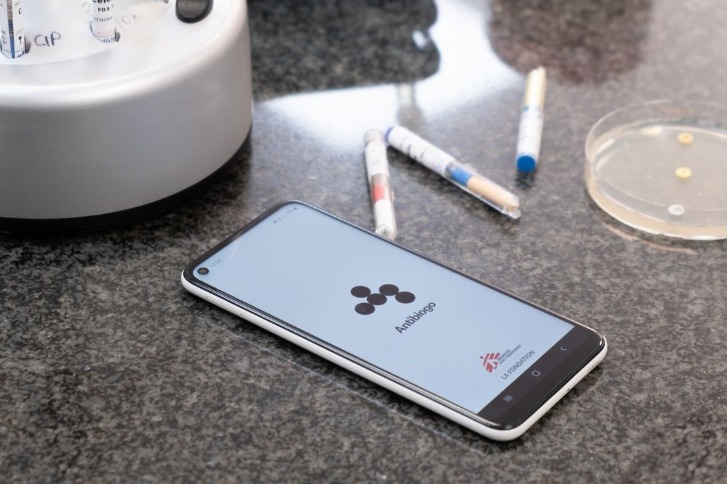
To address this diagnostic bottleneck, Médecins Sans Frontières (Doctors Without Borders) developed “Antibiogo,” an open-source, offline mobile application engineered to assist laboratory workers in measuring and interpreting antibiotic susceptibility tests [8]. Designed to function as a digital microbiology assistant, the application brings expert-level diagnostic interpretation directly to healthcare facilities operating without automated laboratory infrastructure or resident clinical microbiologists [9].
By turning standard, budget-friendly smartphones into diagnostic measurement devices, the software ensures high-precision readings without requiring costly proprietary hardware or continuous high-speed internet connections [10].
How It Works
- The technician sets up a standard disk diffusion test, places antibiotic disks on an agar plate inoculated with the bacteria being tested, and allows the plate to incubate. Once the plate is ready, the technician takes a photograph of it through the Antibiogo application [10].
- The application uses image recognition and artificial intelligence to detect the disks that have been placed on the plate. If the software does not identify a disk automatically, the technician can enter the information manually, which keeps a human in the loop rather than leaving the interpretation entirely to the machine [6].
- Around each disk, there is a clear area where bacteria have not grown. The size of that clear area, called the inhibition zone diameter, indicates how susceptible the bacteria are to that antibiotic. Antibiogo provides a semi-automatic measurement of each zone, and the technician can review, adjust, and approve the measurements before moving forward [10].
- Once the measurements are approved, a second component called the expert system takes over. It applies the latest breakpoints and interpretive rules from European Committee on Antimicrobial Susceptibility Testing (EUCAST) or Clinical and Laboratory Standards Institute (CLSI), the two major international standards for susceptibility testing, and translates the measurements into categories that clinicians understand [6].
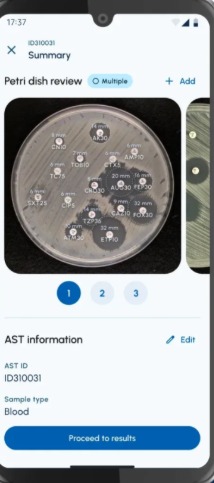
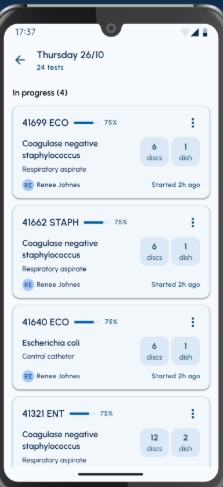
- The final output includes interpretive comments that help the laboratory technician and the clinician understand what the result means for patient care, including flags for unusual resistance patterns or results that warrant a second look [6].
Global Recognition
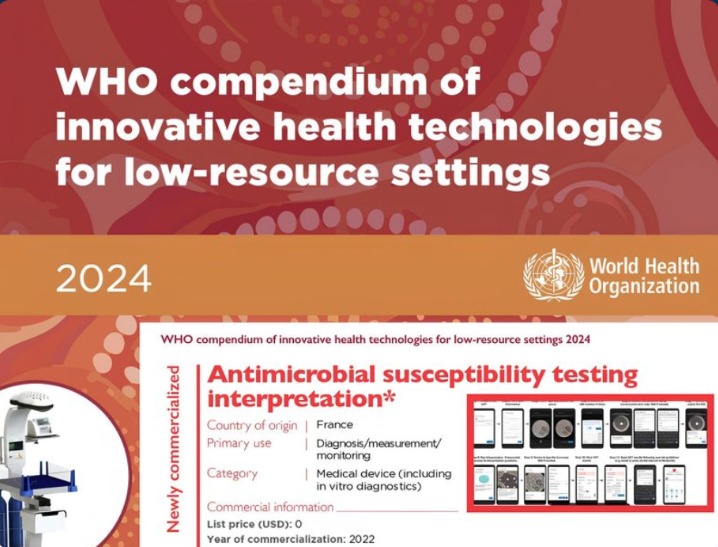
- In 2024, The World Health Organization featured Antibiogo in its Compendium of Innovative Health Technologies for Low-Resource Settings as a clinically recommended tool for strengthening bacterial infection diagnosis and promoting rational antibiotic use and noted that it had reached Technology Readiness Level 9, confirming its maturity and readiness for real-world use [9].
- In 2024, The International Centre for Antimicrobial Resistance Solutions (ICARS) supported the EUCAST Development Laboratory in an independent evaluation that described Antibiogo as an easy-to-use tool [10].
- In May 2022, Antibiogo became the first CE-marked (European Conformity) in vitro diagnostic medical device designed and developed by MSF Foundation, affirming its compliance with European regulatory standards [13]
- In 2025, Antibiogo’s quality management system earned ISO 13485 certification, an international standard for medical device manufacturers. According to Antibiogo’s website, this was a first for a non-governmental initiative in this field and showed that a tool built for low-resource settings could meet the same safety and reliability requirements as commercial devices [9].
Relevance to Africa
Across African healthcare systems, point-of-care microbiology labs frequently struggle with structural supply deficits and staffing constraints [15].
Antibiogo addresses these structural hurdles through multiple field-tailored capabilities:
- Operates entirely offline on standard mobile phones, maintaining complete functionality during power cuts or in locations without cellular networks [16].
- Helps lab personnel reliably interpret complex growth inhibition patterns without needing an on-site specialist [10].
- Eliminates the need to import expensive automated plate readers, allowing low-resource facilities to expand their diagnostic services affordably [9].
- Generates standardized AST data locally using EUCAST and CLSI guidelines, then exports it directly into WHONET (the software WHO uses for GLASS reporting) through a desktop utility called AST Merge [16]. This means a technician’s result on a phone in a district hospital can become part of a national surveillance dataset without retyping or reformatting.
Current Status and Implementation Challenges
- Antibiogo’s accuracy depends on the photograph taken of the test plate, and phones vary in camera quality. The project addresses this by setting a minimum requirement of a 12-megapixel Android camera and by using a simple, self-built “photo booth” to ensure pictures are taken under standardised conditions for correct analysis [17]. Because EUCAST and CLSI guidelines are updated annually, the app’s knowledge base is also updated, and users must download the latest version, making calibration and maintenance an ongoing task rather than a one-off fix.
- While the digital app is free and lightweight, laboratories still need consistent supplies of basic, quality-controlled agar plates and antibiotic discs to perform the tests [18].
- ACE mark is a European certification but, not a global one. The MSF Foundation’s regulatory documentation confirms that, beyond CE marking, the project must meet local regulatory requirements and obtain necessary regulatory approvals for key markets, with a dedicated Software as a Medical Device (SaMD) regulatory role handling this workstream [19].
The Way Forward
Antibiogo has already proven that a technician with a smartphone can produce an interpretation a clinician can act on, and it has been certified as a medical device and used in MSF laboratories across several countries [10]. The question now is whether it becomes standard practice in African laboratories or remains a well-regarded project that never quite settles into routine use.
The answer lies in decisions the app itself cannot make, beginning with regulation. Every country maintains its own medical device authority, and a European CE mark carries no automatic weight before any of them, which means MSF’s regulatory team is working through national approvals in one jurisdiction at a time. A small humanitarian organisation cannot realistically carry that load for an entire continent, so ministries will need to take ownership of their own registration pathways.
A certified device must be updated whenever international treatment guidelines shift and supported when laboratories run into problems, and MSF has itself named long-term financing for maintenance and updates as a priority it has not yet secured [20]. Without that commitment, the tool’s durability rests on funding that goes beyond a single project cycle.
Antibiogo was designed for technicians without specialist microbiology training, but it still assumes they can prepare and read a plate correctly. That is a skill someone has to teach and then keep sharp through supervision and refresher sessions, not a single workshop.
At Ducit Blue Solutions (DBS), as we continue to explore bold ideas leading to emerging solutions and transformative innovations, we remain steadfast in our commitment to advancing patient safety and strengthening health systems that delivers high-quality healthcare services for all. Innovation goes beyond new technologies or approaches but about creating sustainable impact that improves outcomes and builds resilient systems that place people at the centre of care.
References
- Abdi, Y. H., Bashir, S. G., & Ali, S. M. (2026). Economic barriers to antimicrobial susceptibility testing as a structural contributor to antimicrobial resistance in low- and middle-income countries: A narrative review. Infection and Drug Resistance, 19, Article 639809. https://www.dovepress.com/economic-barriers-to-antimicrobial-susceptibility-testing-as-a-structu-peer-reviewed-fulltext-article-IDR
- Antibiogo. (2025a). New feature — AST Merge launch: Strengthening AMR surveillance through Antibiogo. https://www.antibiogo.org/news/strengthening-amr-surveillance-through-antibiogo
- Antibiogo. (2025b). Antibiogo: A year of global recognition and quality excellence. https://www.antibiogo.org/news/global-recognition-and-quality-excellence
- Antibiogo. (n.d.). What do I need to use Antibiogo? https://www.antibiogo.org/support-category/antibiogo-how
- Garcia-Vello, P., Doyle, D., Vollmer, S., Baidjoe, A., Kanapathipillai, R., Farra, A., Michel, J., & Gordillo Gomez, F. (2025). Advancing clinical bacteriology in humanitarian settings: The collaborative role of Médecins Sans Frontières. Journal of Global Antimicrobial Resistance, 44, 449–452. https://www.sciencedirect.com/science/article/pii/S2213716525001894
- Institute for Health Metrics and Evaluation. (2024, September 16). The Lancet: More than 39 million deaths from antibiotic-resistant infections estimated between now and 2050, suggests first global analysis [Press release]. https://www.healthdata.org/news-events/newsroom/news-releases/lancet-more-39-million-deaths-antibiotic-resistant-infections
- International Centre for Antimicrobial Resistance Solutions. (2025). Reflections from the ICARS-supported Antibiogo project as Médecins Sans Frontières scales up expansion of the app. https://icars-global.org/reflections-antibiogo/
- International Centre for Antimicrobial Resistance Solutions. (n.d.). Evaluation of Antibiogo. https://icars-global.org/projects/antibiogo/
- Kumari, S., & Bhatia, R. (2003). Quality assurance in bacteriology and immunology (2nd ed., WHO Regional Publication, South-East Asia Series No. 28). World Health Organization Regional Office for South-East Asia. https://terrance.who.int/mediacentre/data/ebola/training-packages/LQMS/11_cd_rom_quality_assurance_in_bacteriology_and_immunology_2002.pdf
- La Fondation MSF. (2022, June 14). After 5 years of development, Antibiogo becomes the first medical device with CE marking developed by the MSF Foundation! https://fondation.msf.fr/en/newsroom/after-5-years-development-antibiogo-becomes-first-medical-device-ce-marking-developed-msf
- La Fondation MSF. (2023, April 24). Regulatory specialist for software medical device (SaMD) [Job announcement]. https://fondation.msf.fr/sites/default/files/2023-04/April%202023_Antibiogo_Annonce%20Recrutement%20SaMD%20Consultant%20(1).pdf
- La Fondation MSF. (2024). Rapport annuel 2023. https://fondation.msf.fr/sites/default/files/2024-06/FONDA_MSF_RA_2023_DEF.pdf
- Malou, N. (n.d.). Antibiogo. MIT Solve. https://solve.mit.edu/solutions/81992
- Médecins Sans Frontières. (2022). Antibiogo [Project summary]. https://msf-transformation.org/wp-content/uploads/2024/06/Antibiogo-2022-02-14.pdf
- Ministry of Health, United Republic of Tanzania. (2022). National action plan on antimicrobial resistance 2023–2028. https://www.moh.go.tz/storage/app/uploads/public/65c/096/184/65c096184359f155204781.pdf
- U.S. Food and Drug Administration. (n.d.). Antimicrobial resistance and medical devices. https://www.fda.gov/medical-devices/products-and-medical-procedures/antimicrobial-resistance-and-medical-devices
- World Health Organization. (2025). Antimicrobial resistance [Fact sheet]. WHO Regional Office for the Western Pacific. https://www.who.int/westernpacific/newsroom/fact-sheets/detail/antimicrobial-resistance