
Author: Emmanuel Oyelayo
Introduction: The Silent Crisis
Imagine an individual falling ill with a bacterial infection. The individual goes to the hospital, and the doctor prescribes antibiotics (the same drugs that have saved millions of lives for decades). But the medicine doesn’t work. The bacteria have become resistant. He/she is even given a stronger, more expensive antibiotic, and it also fails.
In 2021, the World Health Organization reported that an estimated 1.14 million deaths in Africa were directly caused by AMR, with an additional 4.71 million associated deaths [1].
The Africa CDC notes that AMR is driven by weak laboratory capacity and systemic gaps [2]. A review in Antimicrobial Resistance & Infection Control journal states that sub-Saharan Africa suffers high AMR attributable mortality due to very high infection burden and limited access to care, including appropriate diagnostics [3]
This is where the SeqAfrica Project enters the picture.
What Is SeqAfrica?
Launched in 2019 with support from the UK government’s Fleming Fund (a £265 million UK aid investment to tackle AMR in low- and middle-income countries), SeqAfrica is led by the Technical University of Denmark (DTU) in partnership with three African institutions: the Noguchi Memorial Institute for Medical Research in Ghana, the National Institute for Communicable Diseases in South Africa, and the Institut Pasteur de Dakar in Senegal [4].
According to the Fleming Fund Regional Grant SeqAfrica project page, the network has generated over 25,000 bacterial genomes and 10,000 SARS-CoV-2 genomes (A genome is the complete set of genetic instructions (DNA) inside any living thing, in terms of a biological blueprint or an instruction manual that tells the organism how to function) from 24 countries, supporting more than 60 publications and informing research, and policy [4] (meaning scientists can now identify and track specific bacteria and viruses across Africa, helping to detect outbreaks earlier and guide treatment decisions).
The Core Innovation: A Palm-Sized DNA Decoder
At the heart of SeqAfrica project work is a device called the MinION, a palm-sized DNA sequencer developed by Oxford Nanopore Technologies (ONT) [5]. Specifically, the SeqAfrica project utilises this portable ONT field sequencing device with laptop-based, offline analysis pipelines to expand genomic access to regions across the continent [4].
Traditional laboratory testing can identify bacteria, but genome sequencing provides a full genetic blueprint. This allows scientists to detect resistance genes, track outbreaks, and understand how dangerous strains spread between people, animals, and the environment.

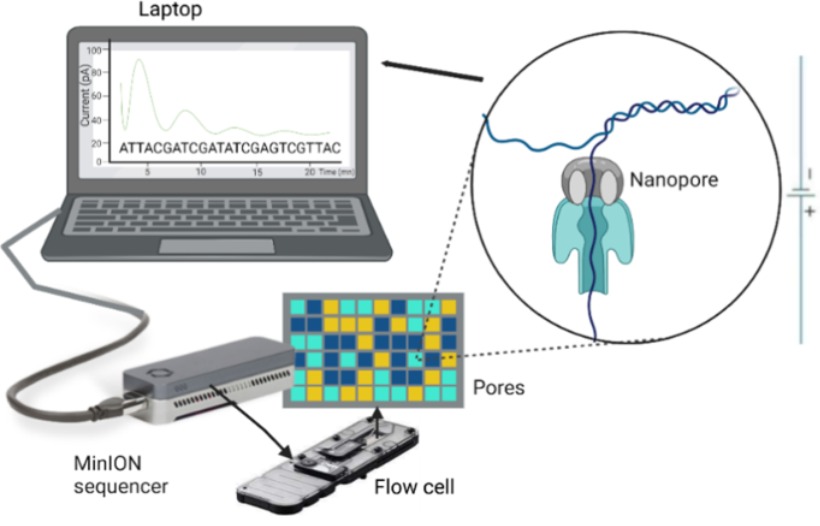
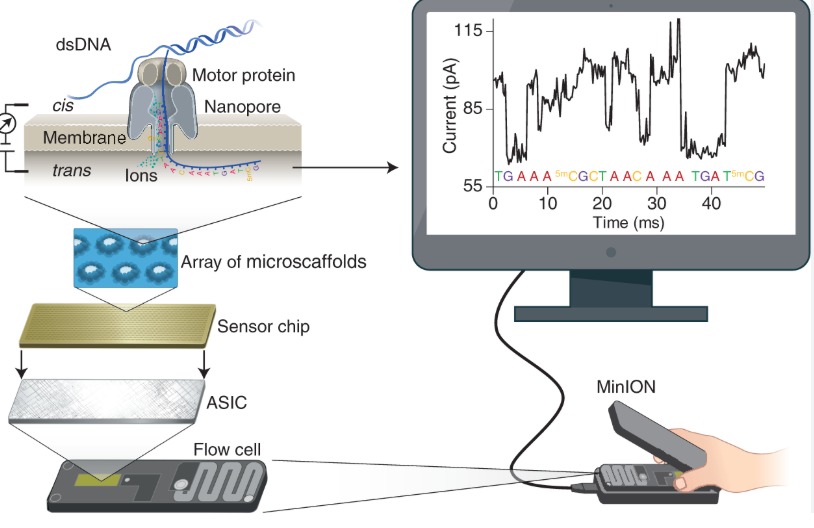
How does it work? Imagine a bacterium’s DNA as a very long necklace made of four different coloured beads. The MinION works by threading this “necklace” through an incredibly tiny hole called a nanopore. As the necklace passes through this microscopic pore, the machine reads the colours of the beads one by one, instantly translating the entire genetic sequence into digital data containing a text file with the letters A, T, G and C (components of the DNA).
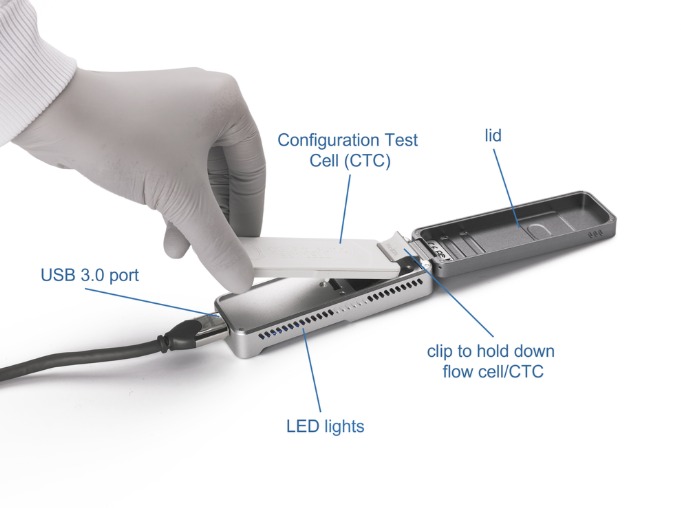
The MinION’s low start-up costs and minimal setup requirements compared to the cost of traditional sequencing machines make it ideal for smaller laboratories in resource-limited settings [5].
The Four-Step Workflow
SeqAfrica’s team developed easy-to-use “sample-to-analysis” protocols designed to use consumables available in Africa, with minimal non-standard equipment for cost-effectiveness. Here is the journey:
Step 1
Sample Preparation: It starts with a bacterial sample, perhaps from a patient with a fever or from a piece of chicken at a local market. Scientists extract the DNA from the bacteria [6].
Step 2
Library Construction: The extracted DNA is prepared for sequencing by attaching tiny “adapters” that act like a GPS, guiding the DNA strands to the nanopores [6].
Step 3
Sequencing: The prepared DNA is dropped onto the MinION’s Flow Cell (sequencing chip), which is packed with over 2,000 nanopores. The chip is inserted into the device, connected to a laptop, and sequencing begins automatically [6].
Step 4
Data Analysis: The raw data is analysed using EPI2ME, a software platform favoured by SeqAfrica for its offline capability and ease of use. EPI2ME automatically handles quality control and detection of resistance genes [7]
How This Impacts the Average African
- Hospitals use SeqAfrica data to identify which resistant strains are circulating locally. This information helps health officials update treatment guidelines, ensuring that when you need antibiotics, you receive the correct drug on the first try. According to the University of Ghana website, SeqAfrica data was recently used to inform healthcare actions at the Eastern Regional Hospital in Koforidua, where healthcare workers explored strategies to tackle drug resistance [8].
- SeqAfrica monitors bacteria in livestock and poultry under a One Health approach, integrating human, animal, and environmental health sectors [4]. In Zimbabwe, SeqAfrica-trained scientist Peter Katsande analysed AMR data on E. coli in poultry, identifying drug-resistant genes and characterising transmission dynamics in the country’s poultry sector [9]. This means the meat, eggs, and dairy you buy are safer and less likely to carry drug-resistant bacteria.
- SeqAfrica data has been used to track how resistant bacteria spread between patients and staff, enabling targeted infection control. This means when you or a family member is hospitalised, your risk of catching a dangerous infection is significantly reduced.
- July is Group B Strep Awareness Month. Group B Streptococcus (GBS) is the leading cause of neonatal meningitis and sepsis in developing countries. While SeqAfrica’s primary focus is AMR surveillance, its genomic capabilities also help track GBS. This means protecting Africa’s newborns from life-threatening infections, giving them a healthier start to life.
Challenges and Limitations
- Cost of consumables: Reagents and flow cells are expensive, with costs often higher in low- and middle-income countries than in high-income countries due to shipping and supply chain challenges. According to Mukhwana et al. (2024) in Nature Index, African researchers pay significantly more for laboratory supplies than researchers in richer countries [10].
- Need for trained bioinformaticians: Africa faces a critical shortage of skilled genomics and bioinformatics personnel. According to Ondoa et al. (2026) in Nature Communications, prior to the COVID-19 pandemic, 87.3% of national public health institutions in Africa had extremely limited genomics and bioinformatics literacy and expertise [11].
- Sustaining capacity amid funding constraints: Global funding constraints, procurement bottlenecks, and workforce retention issues threaten the long-term sustainability of genomic surveillance capacity. According to Nilsson et al. (2025) in Frontiers in Public Health, persistent challenges in procurement, workforce retention, and metadata completeness have been documented across SeqAfrica implementation [12].
How Can Africa Step Up as a Continent?
SeqAfrica’s success proves that genomic surveillance is feasible in Africa. To make this the norm:
- Embedding genomic surveillance into national AMR action plans with dedicated budgets is essential. As Africa continues to invest in genomic health infrastructure, SeqAfrica provides a proven model for embedding pathogen genomics into public health strategies.
- Reform university curricula to include genomics and bioinformatics. SeqAfrica has made training materials freely available online [4]. The project has trained over 200 researchers and laboratory staff through workshops and bioinformatics training [4].
- More young Africans should pursue STEM careers. While some are already making strides in these fields, bioinformatics has a significant talent gap across the continent that urgently needs to be filled. They can also use social media to spread the life-saving message: “Don’t misuse antibiotics”.
- Regional cooperation is key. AMR knows no borders. SeqAfrica’s model of regional hubs and data sharing across countries is the blueprint for the future.
In the fight against antimicrobial resistance, speed and information save lives. By placing powerful genomic tools into the hands of African scientists, SeqAfrica is helping the continent detect superbugs faster and make better treatment decisions, which builds a stronger defence against one of the world’s most pressing health threats
At Ducit Blue Solutions (DBS), as we continue to explore bold ideas leading to emerging solutions and transformative innovations, we remain steadfast in our commitment to advancing patient safety and strengthening health systems that delivers high-quality healthcare services for all. Innovation goes beyond new technologies or approaches but about creating sustainable impact that improves outcomes and builds resilient systems that place people at the centre of care.
References
- World Health Organization Regional Office for Africa. (2025, December 3). Congo hosts Africa’s first simulation exercise on antimicrobial resistance surveillance. https://www.afro.who.int/countries/congo/news/congo-hosts-africas-first-simulation-exercise-antimicrobial-resistance-surveillance
- Africa Centres for Disease Control and Prevention. (2023, November 20). The hidden pandemic threatening Africa’s progress. Africa CDC. https://africacdc.org/news-item/the-hidden-pandemic-threatening-africas-progress/
- Antimicrobial Stewardship Study Group. (2024). Implementation and evaluation of AMR surveillance pipelines in resource-limited settings. Antimicrobial Resistance & Infection Control, 13, Article 1472. https://doi.org/10.1186/s13756-024-01472-8
- National Food Institute, Technical University of Denmark. (n.d.). SeqAfrica: Strengthening sequencing capacity for AMR surveillance in Africa. DTU Food. https://www.food.dtu.dk/english/Topics/Antimicrobial-resistance/SeqAfrica
- Oxford Nanopore Technologies. (n.d.). MinION: Portable DNA and RNA sequencing. Oxford Nanopore Technologies. https://nanoporetech.com/products/sequence/minion
- National Food Institute, Technical University of Denmark. (n.d.). SeqAfrica resources and bioinformatics pipelines. DTU Food. https://www.food.dtu.dk/english/topics/antimicrobial-resistance/seqafrica/seqafrica-resources
- Global Health AMR Research Consortium. (2026). One Health genomic approaches to tracking antimicrobial resistance in low- and middle-income countries. Frontiers in Public Health, 14, Article 1756324. https://doi.org/10.3389/fpubh.2026.1756324
- Noguchi Memorial Institute for Medical Research. (2024, November 18). SeqAfrica expands AMR genomics sequencing efforts across Africa in next phase. University of Ghana. https://noguchi.ug.edu.gh/2024/11/seqafrica-expands-amr-genomics-sequencing-efforts-across-africa-in-next-phase/
- PubMed Central. (2025). Genomic epidemiology and plasmid-mediated resistance tracking in African clinical isolates. PMC Open Access, PMC12284406. https://pmc.ncbi.nlm.nih.gov/articles/PMC12284406/
- Mukhwana, A., Shorinola, O., Ndlovu, D.-F., & Osaso, J. (2024). Slow, difficult and expensive: How the lab supplies market is crippling African science. Nature Index. https://atlt.foventa.africa/wp-content/uploads/2025/02/FINAL-SFA-Foundation-slides-on-procurement-in-Africa-by-Deborah.pptx.pdf
- Onywera, H., Tanui, C. K., Ayitewala, A., Kasembeli, A. N., Diagne, M. M., & Tessema, S. K. (2026). Harnessing the power of virtual reality technology to enhance public health genomics skills in Africa. Nature Communications, 17(1), Article 1490. https://doi.org/10.1038/s41467-026-68874-7
- Nilsson, P. N., Gibson, C. T., Thornval, N. R., et al. (2025). SeqAfrica: empowering Africa’s fight against antimicrobial resistance through genomics. Frontiers in Public Health, 13, 1716498. https://www.frontiersin.org/journals/public-health/articles/10.3389/fpubh.2025.1716498/full